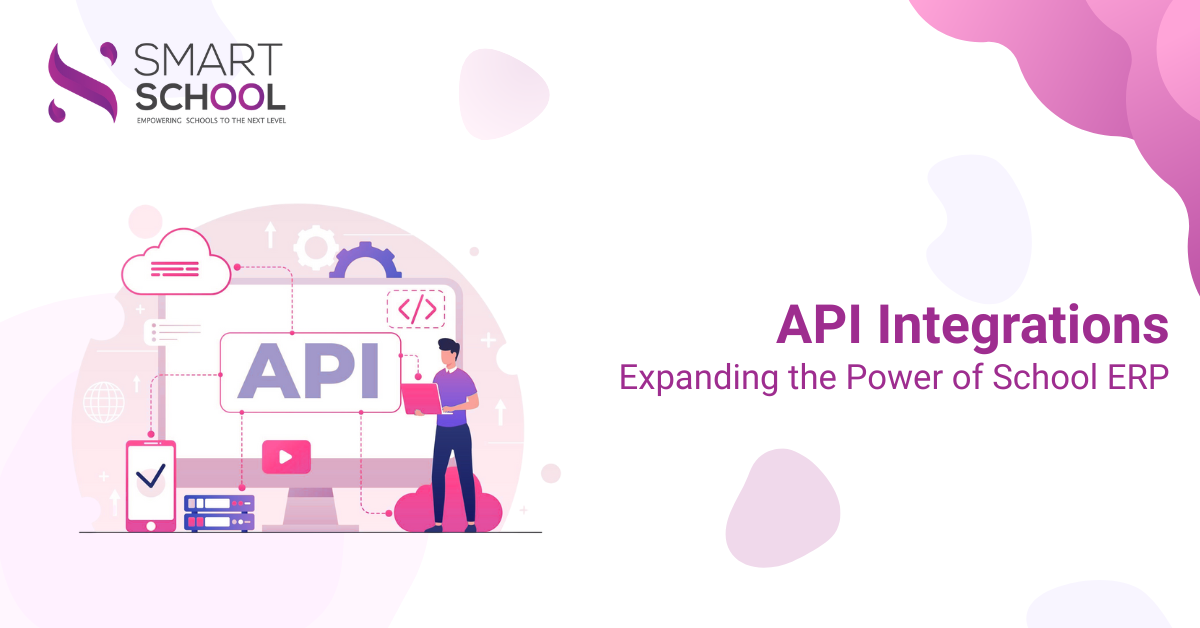
Schools are adopting smarter technologies to streamline their daily operations. A School ERP has already proven to be an essential system for automating academic, administrative, and financial workflows. However, as institutions grow and the need for interconnectivity increases, a standalone school management system may not be enough. This is where API integrations play a transformative role.
API (Application Programming Interface) integrations extend the capability of a School ERP by allowing it to communicate with various external applications. Whether it’s payment gateways, mobile apps, Learning Management Systems (LMS), or biometric devices, API connectivity ensures smooth data flow, reduces manual tasks, and enhances overall efficiency.
In this blog, we explore how API integrations expand the power of School ERP and why they are crucial for modern educational institutions.
APIs act as bridges between two or more software systems. When a school management software uses APIs, it can connect with third-party platforms without the need for complex manual processes or additional plugins.
For example:
API integrations allow schools to move beyond basic automation and create a connected, unified, and scalable digital ecosystem.
One of the biggest challenges schools face is fragmented data spread across different systems. API integrations solve this by enabling automatic data synchronization.
For instance, when a student’s details are updated in the School ERP, the changes automatically reflect in:
This eliminates confusion, reduces duplication, and ensures that every department works with accurate and up-to-date information.
Parents often want quick access to fee details, attendance reports, exam schedules, and announcements. API integrations help School management systems connect with mobile apps or parent portals to deliver this information instantly.
Teachers benefit as well. When ERP connects with LMS or Google Classroom via APIs, they can:
For students, this integration offers a unified experience where academic resources, notifications, and communication channels come together in one platform.
A School ERP becomes significantly more powerful when connected with systems that automate:
API-powered automation reduces repetitive tasks, saves time, and minimizes human errors. Schools can devote more time to student-focused improvements rather than administrative complexity.4. Secure and Reliable Data Exchange
With increasing digital adoption, data security is a top priority for educational institutions. API integrations enable secure transmission of information through standardized protocols. Sensitive data such as student records, financial transactions, or staff information stays protected with encryption mechanisms.
A well-integrated school management system ensures compliance, reduces risks, and maintains data integrity across all connected applications.
Every school operates differently. Some require SMS gateways for communication, some depend heavily on digital learning platforms, and others require strong accounting integrations.
API integrations play a critical role in strengthening a school’s financial processes. When the ERP is connected with:
The finance team benefits from real-time tracking, automated reports, and seamless invoice generation. Parents also enjoy a convenient and secure fee payment experience through integrated digital methods.
Effective communication is essential in school operations. Through API integrations with SMS gateways, email services, and mobile applications, School ERP ensures that:
This real-time communication fosters transparency and builds stronger relationships between schools and families.
Here are some essential API integrations that enhance the potential of a School ERP:
Enable online fee payment, automated receipts, and real-time transaction status.
Seamlessly update attendance records for students and staff.
Send automated alerts, fee reminders, attendance notifications, and announcements.
Connect the school ERP with digital learning platforms for a complete academic management experience.
Ensure smooth transfer of financial data for accurate budgeting and reporting.
Offer real-time school bus tracking for enhanced student safety.
Sync student data, reports, schedules, and communication channels for hassle-free access.
With growing expectations for fast, reliable, and unified school management, API integrations will continue to play a pivotal role. Schools are increasingly adopting cloud-based ERP solutions that support seamless integration with hundreds of applications. This opens a wide range of possibilities:
A School ERP with strong integration capabilities becomes the digital backbone of modern educational institutions.
API integrations significantly expand the power of School ERP by creating a unified, intelligent, and automated environment. They help schools streamline operations, improve communication, enhance learning experiences, and adopt efficient digital workflows. As educational institutions continue to embrace digital transformation, the value of API-integrated school management software becomes even more evident.
Schools that adopt an API-ready ERP system will not only improve their current operations but also prepare themselves for future technological advancements. In an era where connectivity drives efficiency, API integrations are no longer optional they are essential.