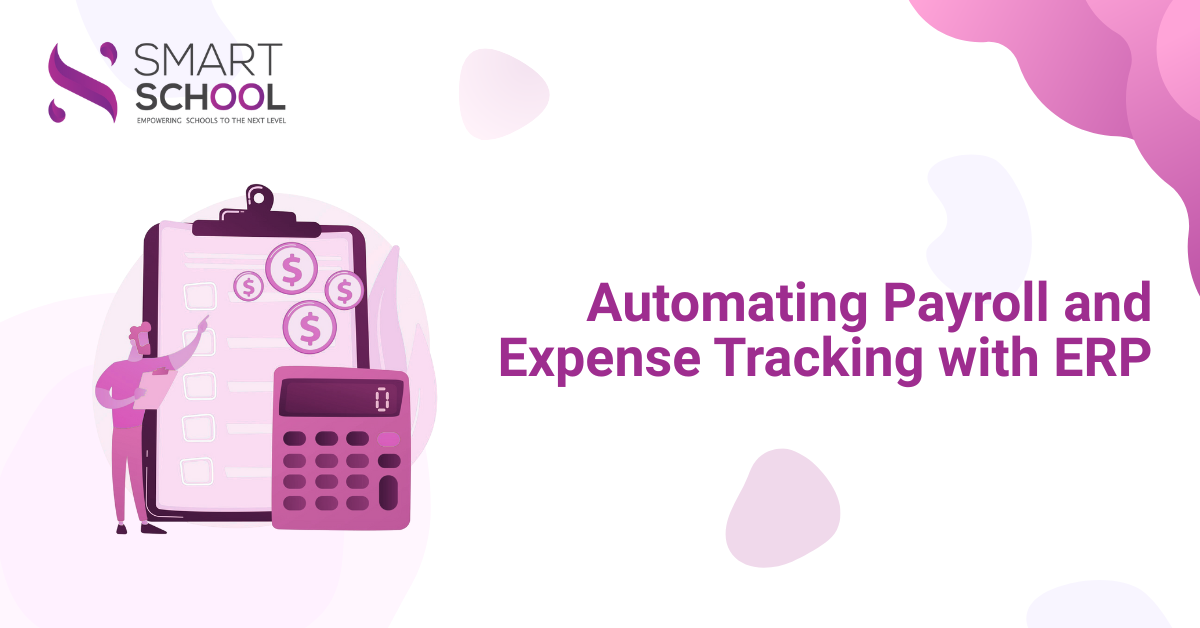
Managing finances efficiently is a key part of maintaining smooth operations. From teacher salaries and staff payments to departmental budgets and daily expenses, financial accuracy is crucial. However, manual handling of payroll and expense tracking can be both time-consuming and prone to human error. This is where a School ERP or School Management System steps in, offering automated solutions that simplify the entire process and enhance financial transparency.
Traditionally, schools and colleges have relied on spreadsheets or standalone software to manage employee salaries, deductions, and reimbursements. While this approach may work for smaller institutions, it becomes increasingly complex as the organization grows.
Manual payroll processing involves calculating attendance, leave, deductions, and taxes — often leading to inconsistencies and delayed salary disbursements. Similarly, expense management without automation can result in inaccurate reporting, untracked reimbursements, and limited visibility into financial performance.
These challenges not only impact staff satisfaction but can also affect decision-making and compliance with financial regulations.
An ERP system integrates all financial and HR functions into a single platform, automating salary processing and ensuring accurate record-keeping. Here’s how ERP transforms payroll management:
With an ERP-enabled payroll system, salary computation becomes effortless. The system automatically calculates earnings, deductions, bonuses, and taxes based on predefined formulas. Integration with the attendance and leave modules ensures that salaries are processed accurately, reducing administrative effort and the risk of manual mistakes.
All employee details — including designation, department, grade, and salary structure — are stored securely within the ERP system. This eliminates the need for repetitive data entry and ensures that all records are up to date, making payroll processing faster and more reliable.
Staying compliant with tax and statutory regulations is critical. ERP systems are designed to automatically apply relevant tax rules, generate pay slips with accurate deductions, and prepare compliance reports. This automation ensures timely submission of statutory requirements such as PF, ESI, and TDS.
Generating payslips manually can be a daunting task during month-end. ERP software simplifies this process by enabling one-click pay slip generation for all employees. Digital payslips can be instantly shared with staff through their respective login portals, ensuring transparency and accessibility.
The payroll dashboard in ERP provides real-time data on salary disbursements, deductions, and total payroll expenses. Administrators can easily track expenditure trends and forecast future budgets with data-driven insights.
Expense tracking is another crucial area where ERP brings significant improvement. From petty cash to departmental spending, ERP ensures that every transaction is recorded and analyzed effectively.
ERP provides a centralized system to record all types of expenses — whether it’s classroom maintenance, equipment purchase, or administrative costs. This eliminates paper-based tracking and ensures that every financial transaction is documented digitally.
The ERP system allows schools to set specific budgets for departments and track expenses in real time. If a department exceeds its allocated limit, the system notifies administrators immediately. This proactive control helps in maintaining financial discipline and preventing budget overruns.
Reimbursement claims from teachers or staff can be processed efficiently through the ERP portal. Employees can submit claims online, attach receipts, and track approval status. Once approved, reimbursements are automatically included in the next payroll cycle, saving time and effort for both the employee and the accounts team.
The ERP system categorizes expenses into different heads — such as utilities, maintenance, transportation, and academic materials — making it easy to analyze where funds are being utilized. Reports can be generated monthly, quarterly, or yearly, offering detailed insights into the institution’s financial performance.
ERP solutions seamlessly integrate payroll and expense data with the accounting module, ensuring that all transactions reflect automatically in the financial statements. This eliminates duplicate entries, enhances accuracy, and simplifies audit preparation.
Implementing an ERP-based automation system for payroll and expense tracking delivers measurable benefits to schools and colleges:
Time Efficiency: Reduces manual work and speeds up salary disbursement and financial processing.
Error Reduction: Eliminates human errors in calculations and ensures accurate data entry.
Transparency: Enables staff to access their pay slips, expense records, and approvals through self-service portals.
Financial Control: Provides clear visibility into income, expenses, and budget utilization.
Regulatory Compliance: Ensures adherence to tax and statutory obligations automatically.
Data Security: Protects sensitive financial and employee data with advanced encryption and access controls.
Financial operations form the backbone of any educational institution. A robust school management software not only simplifies administrative tasks but also enhances financial governance. With ERP automation, school administrators can shift their focus from manual data handling to strategic decision-making.
Moreover, when payroll, HR, and accounting functions are interconnected, it ensures consistency across all departments. The system can also generate instant financial summaries that help management teams evaluate costs and make better-informed decisions for future planning.
As schools and colleges continue to embrace digital transformation, automating financial processes has become a necessity rather than a choice. An ERP-powered School Management System simplifies payroll, ensures accuracy in salary processing, and keeps track of every expense efficiently.
By integrating automation into financial operations, institutions can achieve higher productivity, better compliance, and improved transparency — all contributing to a smarter and more efficient administrative ecosystem.
If your institution is still relying on manual methods for payroll and expense management, it’s time to switch to an advanced School ERP solution. Empower your campus with technology that brings accuracy, efficiency, and peace of mind.